

SPANISH RULE IN THE AMERICAS
After Columbus died in 1506, the allure of abundant precious metals soon brought Spanish and Portuguese conquistadors, explorers and settlers back to the Caribbean Islands, Central and South America. They discovered new territories, opened additional trade routes and sought to conquer native tribes. Their sovereigns willingly supported these voyages– anticipating increased wealth and more power.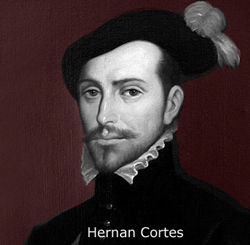 Two of the most famous Spanish conquistadors were Hernan Cortes and Francisco Pizarro. In 1519, Cortes conquered the Aztec Empire in Mexico. Pizarro, a distant cousin of Cortes, first arrived in Panama in 1513 with Vasco Nunez de Balboa. While exploring western South America, he repeatedly encountered natives who shared tales of a highly-evolved and wealthy civilization to the south with “rooms full of gold”. He conquered the Incas in 1531.
In early American governments the Europeans were more heavy-handed. Wealth and power was primarily reserved for rulers and friends, but not the common man. This ruthless approach lasted almost four hundred years– from the time of Columbus until the Spanish War 1898. The outcome: unstable governments and leaders who were often completely self-serving and less-than-interested or supportive of freedom. This created huge divides between the “haves” and the “have-nots”—with the majority of the population living in poverty.
Spain dictated both the secular laws and religion for the New World—a largely successful approach given there was virtually no separation between church and state. Unlike our country’s beginnings, the rest of the Americas and those who led them failed to grasp the concept of balancing self-reliance and personal responsibility with working together for the common good.
Colonizing Middle North America During the 16th century, three European nations– Spain, France, and England– all attempted to colonize North America along the coast between northern Florida and Maine without success.
[Return to the Top of this Page]
THE SPANISH IN NORTH AMERICA
Spanish interest in North America was primarily limited to outposts and forts located along their shipping lanes. In 1565, Spanish Admiral and Governor of Florida, Don Pedro Menedez de Aviles, established a settlement called St. Augustine. It became the oldest continuously occupied European-established port in the United States.THE FRENCH ATTEMPT AT COLONIZATION
In the late 16th century, France became embroiled in several decades of violent religious wars. A group known as Huguenots chose to leave their Catholic faith for Protestantism. This bold choice resulted in demands for their extermination and tens of thousands were systematically massacred.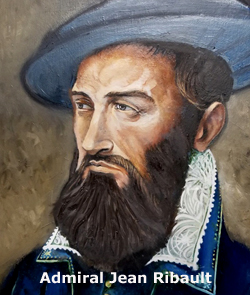 In 1562, a French nobleman, Gaspard de Coligny, a highly-respected military reformer and prominent Huguenot leader, petitioned and won the Queen’s permission for the faction to leave France and settle in North America. The first expedition was led by Admiral Jean Ribault to Parris Island, South Carolina and failed miserably. A small group of troops were left on the island to build Charlesfort, but abandoned the site after a year. Without provisions and lacking leadership, the settlement was doomed as well by the inability to manage increasingly tenuous relations with the native population.
In 1564, Rene Goulaine de Laudonniere founded a second colony along the St. John’s River near Jacksonville, Florida also intended for the Huguenots. It was named La Caroline, (“land of Charles”) in honor of King Charles IX.
Early on, the French survived by trading with the Native Americans. But in time their failure to adapt and learn the fishing, hunting, and farming skills so essential to survival left them destitute. In desperation, they turned to robbing or abducting natives; which only increased tension in the already fragile relations. Challenged by settling land with little access to fresh water, and extreme weather patterns, the colonists were unable to develop the means to make use of the abundant natural resources.
De Laudonniere soon made the decision to permanently abandon the colony. While the group was making preparations to depart, they were astonished by the unexpected arrival of several ships. John Hawkins, an English privateer, sold the French a vessel and supplies. In August, 1565, while waiting for favorable winds, another ship arrived bringing more settlers and supplies. Buoyed by this influx, La Caroline now with a population of about 800, flourished for a month.
In early September, a Spanish fleet sailed up the Saint John’s River with orders from Spain to destroy La Caroline. The Spanish attacked the French, but horrific weather conditions forced them to retreat. Most of the French ships sailed after the Spanish, but the hurricane drove the French out to sea.
Meanwhile, the Spanish regrouped and attacked the French by land. More than 140 Frenchmen who had remained at the fort were killed. Within a few days, the French ships limped back into the harbor, badly battered by the storm. The Spanish, now holding the strategic advantage, ordered the French to surrender. Separating them into groups of ten, each individual was asked which they would choose: to denounce their new faith or face execution. All but a few chose execution. Those who denounced their faith were taken prisoners. Unfortunately, La Caroline quickly became France’s second failure at colonizing in the New World.
Fort Caroline lasted only one year before being destroyed by the Spanish from St. Augustine. The settlement was completely destroyed.
[Return to the Top of this Page]
THE ENGLISH ATTEMPT AT COLONIZATION
In the last half of the 1500’s, Queen Elizabeth I made the decision to settle North America. She recognized an opportunity to claim more land for a burgeoning English population. In addition, she wanted to proselytize the natives and take advantage of the abundant natural resources. By establishing strongholds along the Atlantic Coast, the English could strategically neutralize the long-time Spanish dominance of the shipping lanes.Repeatedly, the English had tried and failed to colonize. One attempt was led by Sir Gilbert Raleigh. His interest was strictly personal financial gain— but it ended badly and he died at sea. After his death, the Queen transferred his charter to his half-brother, Sir Walter Raleigh. In 1585, Raleigh, with 108 men under his command, settled Roanoke, an island off North Carolina.
He named the land Virginia after the Virgin Queen Elizabeth. His Charter granted him land rights which stretched 600 miles from their settlement—from the Carolinas to Maine. For reasons very similar to those in previous attempts, the first settlement was abandoned in 1586 and all but 18 men returned to England.
When the English sailed back in Virginia a year later; the settlement had been destroyed and there was no sign of life. With too little time for planting crops to sustain them, the group now led by John White, had no choice but to return to England. On a second attempt, they left behind over one hundred people– including White’s daughter and a granddaughter, named Virginia Dare. When White came back for a third time in 1590 the Virginia colony was completely deserted and once again, eerily–no evidence of struggle or battle
In spite of daunting odds for the English, their destiny was about to change. Neatly bound by experiences– first at Jamestown and then Plimoth* – the enabling truths of freedom would soon unfold.
* "Plimoth" is the original spelling what we, today, call" Plymouth"
[Return to the Top of this Page]
JAMESTOWN
Pedro de Quejo, a Spanish explorer and slave trader purportedly first discovered the Chesapeake Bay in 1525 while sailing the coast of Georgia, the Carolinas and Virginia. Some eighty years later, even after several failed attempts, the English were still determined to settle in North America. In the early 1600’s, English investors John Smith, Bartholomew Gosnold, Edward Maria Wingfield and others sought support for their plan to colonize North America. In 1605, the Crown under James I expressed interest and their proposal finally received financial backing.
In April, 1606, Lord Popham, the Crown’s first minister, with help from two investment groups—the West Company and London Company, divided North America into two interests— one north and one to the south. Practical circumstances at the time left only New England or the Chesapeake Bay as possible sites. The London Company under the direction of Gosnold, Wingfield and others was granted power to settle the Chesapeake.
During December of 1606, three ships, the Susan Constant, Godspeed, and the Discovery, left London stocked with supplies and 114 “first planters”–men with a variety of skills set on securing their fortunes quickly and then returning to their homeland. Although the settlement was not primarily envisioned as an agricultural endeavor, the Virginia Council, the expedition’s governing body, expected them to sow wheat and other crops.
Almost immediately, the voyage encountered huge challenges. A storm stalled them off the coast of Kent for six weeks. Some suffered and almost died from severe seasickness. From the beginning the men aboard were filled with greed and envy and there was considerable dissension. On February 12, 1607 Smith was arrested for mutiny by the captains of the other ships because of his constant criticism of their decisions. Although Christopher Newport, the fleet’s commander, would have rather hanged Smith, Gosnold convinced him otherwise. By the end of March, they had reached the West Indies, where they took time to rest and recuperate.
On April 10, the English set sail again for the American shore only to once again run into “a vehement tempest”. Smith attributed this incident to divine intervention. “But God, the guider of all good actions,” he wrote, “forcing them by an extream storm to hul night, did drive them by his providence to their desired port, beyond all their expectations, for never any of them had seene that coast.” While others would have abandoned the voyage, Smith remained completely steadfast to his notion God had delivered them safely through the violent storms.
Upon arrival, the English explored the James River and found a suitable area to settle—one blessed with built-in natural protection. By late June, they had sowed a wheat crop, assembled a variety of valuable exports, built a fort, and were convinced they were near a location rich with gold.
Meanwhile, The London Company set up a “government” comprised of seven members—who then elected a president—a position which carried two votes. Under this system, a simple majority could enact laws. The company envisioned that all important or timely decisions would be made locally—much different from the Spanish. However, the practical effect of having eight votes only stifled the process. With two votes allocated to the president, and two more members coming down on his side, any motion could be quashed. In particular, John Smith consistently found his ideas blocked.
Christopher Newport set sail back to England emboldened with good news and hoping to encourage a second expedition. Within weeks of his departure, conditions at Jamestown deteriorated drastically. By September, half the settlers, including the company’s leadership stabilizer, Bartholomew Gosnold, had died from salt water poisoning, dysentery, or typhoid– all resulting from the lack of fresh water. By winter only 40 were still alive. In their darkest days, the natives took pity on the few surviving colonists and brought them food.
During the fall and winter months, John Smith made three trips to trade with the natives to obtain food. During a fourth trip he and two others, John Robinson and Thomas Emry were captured by the Powhatan Confederacy. Robinson and Emry were both killed– but Smith distracted the natives by playing a game of “Fly and Needle” long enough to save his own life.
After being held hostage for days, the natives escorted Smith to their powerful Chief, Wahunsonacock (also known as Powhatan) who sought Smith’s help by asking him to betray the English and officially join their tribe. John Smith also recorded an encounter with Powhatan’s favorite daughter, Pocahontas (who later married Englishman John Rolfe in 1614) claiming she helped save his life.
Conditions in early Jamestown remained troubling. The leaders often found themselves bitterly divided. Some wanted to spend all their time searching for gold instead of focusing on planting crops. Others were in favor of a lighter-handed approach to ruling.
At times, leaders actually confiscated all of the crops produced by the colony leaving the others to starve. The amount of land they could cultivate was limited; and the colonists feared for their safety if they ventured too far from the settlement. Lacking the skills to raise sufficient crops, those who were destitute often changed their allegiance which added to the instability in an already fragile system.
Returning from one of his many expeditions, Smith found Jamestown in complete crisis. He had been away during the “extreame frozen time”. During his absence, several more leaders had drowned. It was his time to lead. The way had been cleared by completely unforeseen circumstances for a man with a unique perspective to step to the forefront.
For one thing, Smith was highly intolerant of idleness. Gathering the surviving colonists together, he announced “He that will not worke shall not eate.” Powerful core principles like self-reliance, now by sheer necessity would penetrate their culture.
From the very beginning until Smith left Jamestown, either he or his now archrival, Captain Newport hunted for gold. Nothing was ever found. But time and experience would change Smith’s perspective. To the London Company, hoping to influence their focus as well, he wrote: “[We] may have the prerogative over the most pleasant places of Europe, Asia, Africa or America, for large and pleasant rivers [;] heaven and earth never agreed better to frame a place for man’s habitation being of our constitutions, were it fully manured and inhabited by an industrious people.”
John Smith had come to understand Virginia’s true inherent value: her natural resources. His astute assessment begs the question, just how fortuitous was the storm which had pushed them to the “Chesapeake?”
In January of 1608, Captain Newport returned with “the first supply” on the John and Francis, including one hundred new settlers.
[Return to the Top of this Page]
 POCAHONTAS
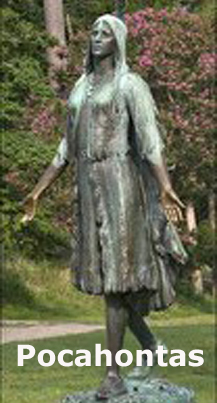
During a later trading expedition, Smith met for the last time with the great chief, Powhatan. who ordered Smith’s execution through poisoned food. His daughter, Pocahantas warned him of her father’s evil intention after which he managed to escape. From the very beginning, she was enamored by the English settlers and very curious about their ways. Pocahantas became a great friend of Smith’s and the English.She eventually converted to Christianity and took a new name: Rebecca. She married John Rolfe, a tobacco planter in 1614 and they had a son named Thomas. After his birth, they visited England where she saw John Smith again for the first time in eight years. She was presented to society as an example of a “civilized savage”. She soon overcame that ill-founded perception and became a darling of the English and was presented to Queen Anne.
“Many of the trees, fruits, vegetables, medicinal plants, animals, fishes and birds were the same or similar to those found in Europe, but they existed in super abundance.”
James Horn
[Return to the Top of this Page]
THE MIRACLE OF PROTECTION
During 1609 with a colony in distress, the London Company dispatched nine ships loaded with provisions and over 500 hundred colonists to Jamestown. The first to sail, the Mary and John left in early May. While the Mary and John was en route, unbeknownst to one another, the Spanish were also heading toward the English– having sent a small warship under the command of Francisco Fernandez de Ecija. Their mission was to assess Jamestown’s military strength. At this point, a gravely weakened Jamestown was ill-prepared to defend itself. The colony was barely alive and had the Spanish reached them, their strategy would have surely changed to one of complete annihilation.It wasn’t to be. With feelings of confidence, Ecija leisurely sailed towards the New World, reaching the Chesapeake Bay on July 14, 1609. He was startled to see a large English ship anchored near the mouth of the Bay. The Spaniards quickly decided warring against such a large ship would be a fruitless endeavor and fled back into the open sea. The English immediately set sail in pursuit. Under the cover of darkness, Ecija and his ship vanished.
Notably the English, in the “Mary and John” arrived just one day prior to the Spanish vessel with no inkling that Jamestown was in such distress when they set sail. Events which unfolded during a 24-hour period decided the fate of Jamestown. Given that purposely sailing within the precision of one day was virtually impossible then, illustrates the great improbability of this miracle. Often, unanticipated storms left vessels lost or stranded for days or even months in the vastness of the waters, yet the “Mary and John” arrived just in time.
“Early America was littered with European failures… But against all odds, Jamestown survived and, by surviving, became the first transatlantic site of an empire. . . Representative government, first established at Jamestown in 1619, would in time blossom into a vibrant political culture. . .”
James Horn
[Return to the Top of this Page]
THE SECOND SUPPLY
In June of 1609, the eight remaining ships left England for Jamestown. The Sea Venture, carrying Sir Thomas Gates, the new Governor, led the way. While approaching North America, the fleet encountered a terrific storm and the Sea Venture became separated from the others, but somehow mysteriously found its way to the shores of Bermuda.In August, the seven other ships landed at Jamestown bringing with them approximately 400 new settlers and badly-needed provisions. With their arrival, the population grew to over 500. But the large number of new arrivals only added to the discord among Jamestown’s leaders as to how to care for and assimilate this large number into the already fragile system.
During the first two years at Jamestown, Smith managed to achieve a somewhat delicate peace with the Powhatan tribe and other local natives with his mostly iron-fisted approach. But soon after he departed, the natives grew tired of the English’s unpredictable behavior and sometimes brutal treatment. They too, were battling for survival during the severe drought. The tribe turned hostile and began killing any English traders or hunters who dared to venture outside the settlement. By fall, they lay in siege, simply waiting for the colonists to die from starvation.
The winter conditions in Jamestown were beyond horrendous—and the colonists were totally unprepared. The increase in their numbers added significantly to the strain on already meager supplies. Drought had destroyed the growing season of 1609 leaving the colony extremely vulnerable with very little for winter.
Adding to their struggle, much of the world was in the middle of a geographic phenomenon known as the Little Ice Age and was experiencing record low temperatures. To survive they ate worms, rodents, cats, dogs, horses and even the human flesh of those who succumbed to the extreme weather conditions. Struggling to stay warm in the unusually harsh winter, even wood from houses of the deceased was burned. By late spring, 440 members of the colony had perished leaving only 60 weak and starving inhabitants alive.
[Return to the Top of this Page]
AN IMPROBABLY MEETING
After the unanticipated separation at sea in 1609, a ferocious storm caused serious leaking between the unset timbers and the heavy seas forced out new chalking on the Sea Venture.For three days the crew and passengers bailed until completely exhausted. On the July 25, 1609, they decided they had no chance for survival unless they deliberately ran the ship into the reef off of Bermuda. Amazingly, all safely went ashore. For ten months, they lived in Bermuda and built two new ships, Deliverance and the Patience, made of parts from Sea Venture and natural materials.
On May 10, 1610, the Deliverance and Patience left Bermuda arriving two weeks later in Jamestown loaded with supplies and 150 passengers. Little did they know what horrific circumstances awaited them– a colony almost completely annihilated? After arriving in Virginia, Sir Thomas Gates relieved the former Company President, George Percy. He surveyed the dismal conditions and quickly concluded that Jamestown must be abandoned.
After John Smith left Jamestown and returned to England in September of 1609, he began writing about his experiences which sparked renewed interest in the Virginia Colony. New investors joined the effort and clergy made moral appeals for assistance for the stranded colony. On April 1, 1610, three ships set sail from England. One ship carried Thomas West, the Deputy Governor.
Meanwhile, in Jamestown, at mid-day on the 7th of June 1610, the few remaining survivors set sail down the James River to begin their arduous return voyage to England. They moored off Mulberry Island awaiting the outgoing tide when miraculously, a long boat with an advance party from the English ships appeared. After some intense negotiation, West’s Company finally convinced the colonists that they must return. In but a few minutes, the few remaining settlers would have been lost in the vastness of the open sea and Jamestown would have been nothing more than a memory. Of this experience John Smith wrote, “God…would not have it [the colony] so abandoned.” Although the challenges at Jamestown would not end, the struggling colony was about to begin a new chapter.
[Return to the Top of this Page]
GOVERNMENT AND ECONOMIC EXPERIMENTS
During the years after Smith, several government and business models were tried. Some styles were very strict, others ineffective and a few actually worked. When Governor West arrived, he immediately organized the settlers militarily seeking to encourage self-discipline. He organized the “landmen” into groups of “tennes, twenties, and so upwards.” Each group was assigned military and agricultural duties in the communal organization. Still, within six months a third died, mostly from disease rampant because of the constant struggle for enough food and water. During most of the West years, war raged between the natives and the English, forcing the settlers to stay close to the original settlement.Upon his arrival in 1611, Sir Thomas Dale, as marshal, instituted a martial law later known as Dale’s Code. He levied capital punishment even for trivial crimes such as theft –punishment he felt was necessary to ensure the community’s long-term survival.
Describing the nature of Jamestown in the period between 1612 and 1614, a Spanish captive, Don Diego de Molina, wrote of the common man as “held captive by their masters.” He continued, “they look me in the face and ask: what is the king of Spain doing? Where is his mercy?” Under the communal and martial law conditions, Jamestown had returned nothing to the London Company.
In perhaps Dale’s most important contribution, he abandoned the failing communal agricultural system in the spring of 1613 and began assigning three acres of land to the “ancient planters” and later to others. Agricultural production soared as a result of the shift to private ownership.
Dale later served as Governor from 1614-16. In the spring of 1614, he negotiated an agreement with the Powhatan Chief, Wahunsonacock, to end “the conflict.” The Chief had finally realized how futile it was to continue war against the endless waves of English immigrants. With peace achieved, the English moved their settlements upriver to areas described as “exceeding healthfull.”
John Rolfe had arrived in May of 1610. In 1611, he planted the first Spanish tobacco seeds he had brought with him. A new cash business was born. In time, successful tobacco plantations sprang up along the James and other rivers.
Shortly before Thomas Dale left in 1616, he asked Rolfe to summarize conditions. Rolfe described three types of peoples: officers, laborers, and farmers. The officers were in charge of defense, the laborers were either skilled or general, with all receiving common goods from the general store. Of the farmers, Rolfe wrote, “live[d] at most ease,” being obliged to defend, work for the Company one month a year, support himself and his family and taxed two barrels of corn a year. The rest of the time they were free to work for themselves.
His record continues about qualities most needed: “good and sufficient men, as well of birth and quallyty to commands: . . . Labourers and husbondmen: . . . . [that] the Land might yerely abound with come and other provisions for mans sustenaunce: . . . commodyties of divers kindes might be reaped yerely, and sought after: and many thinges. . . might come with ease to establishe a firme and perfect Common-weale.”
Between 1609 and 1616, 1,500 settlers arrived in Jamestown, but only 350 ultimately survived. Most died from either disease or starvation. In 1616, to encourage continued economic growth, and stay the constant struggle for providing enough, the government began offering land for private ownership as an added incentive. In the agreement laborers who arrived before 1616 received 100 acres and those who came unencumbered after that date received 50 acres.
In 1618, major territorial shifts divided Jamestown into four regions. Fearing the severe martial code would impede continued immigration, the London Company instructed Governor George Yeardley, to institute “just laws for the happy guiding and governing of the people.” Two councils were created– one appointed by the Company and one elected by the “people.” The Company’s idea of government was that “every man will more willingly obey laws to which he hath yielded his consent.” In addition, English common law and legal practices were adopted. Jamestown was initially founded by investors for the purpose of returning reasonable profits. By now, experience had taught them that effectively “involving” the settlers benefitted the overall productivity. The permanency and style of a principled government was beginning to take shape.
By 1624, the London Company failed but Jamestown did not. In time, the export of the abundant natural resources would continue to provide the necessary long-term economic support, stability, and growth.
[Return to the Top of this Page]
THE INFLUENCE OF JAMESTOWN
Jamestown was the beginning of a new but critically important chapter— a bitter but eventually successful experiment. From Captain Smith came the idea of valuing natural resources— the wealth of land and the crops it yielded if managed properly— something the rest of Europe had failed to comprehend. This knowledge didn’t temper hardships, instead from these harsh and unrelenting trials came a deeper, truer understanding.David McCullough, speaking of the influences of Plymouth and Jamestown, noted that by the time of the Revolutionary War, hard work coupled with private ownership, personal responsibility, merit trumping birthright, self-government, and the rule of law had become so embedded that America was now the wealthiest per capita nation on earth.
Great character and understanding triumphed over unspeakable adversity. That, coupled with miracles, preserved the principles which would become the foundation of America’s government and society.
[Return to the Top of this Page]
This Website Created by Mark Mansius
and Designed by Website Usability by Design
Copyright by Mark Mansius 2021, All rights reserved